Full Proposal
Jabiru Masterplan Pro:
The Community Contribution
A Proposal for a Living, Breathing, and Resilient Jabiru
Version
Unsolicited
Date
April 2026
Authors
Cosmic Dust & Little Hope
Part 1
The Vision — Why We Need a Better Plan
The official Jabiru Masterplan was conceived with genuine ambition — a landmark vision for a World Heritage town. We offer this contribution not to dismiss that ambition, but to propose a different path to the same destination.
Jabiru is not a museum; it is a home. A successful masterplan must serve the people who live here — including the Mirarr people, long-term residents, and the children who grow up here — before it serves the visitor.
Our proposal, The Community Contribution, is a bottom-up alternative. It is not about building one big thing, but about nurturing a diverse ecosystem of places, experiences, and opportunities. It is a plan to make Jabiru a town where culture lives, not where it is merely watched.
Our guiding principle is simple: Build the community first, and the tourists will come.
Analogy
A Tale of Two Processors: CPU vs. GPU
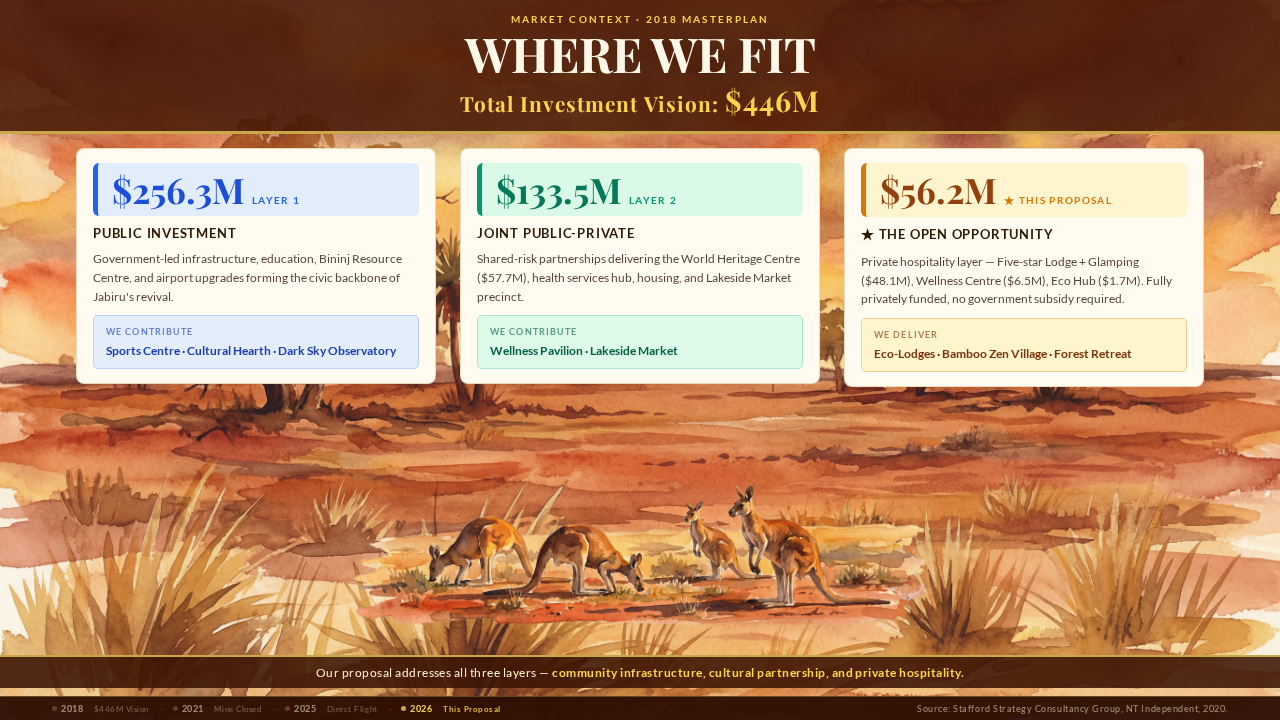
The 2018 Jabiru Masterplan — a $446M vision co-authored by the Gundjeihmi Aboriginal Corporation and the Northern Territory Government — identified the same gap. Of that total, $56.2M was allocated to privately funded commercial projects, including $48.1M for a five-star lodge and glamping facilities.
The opportunity remains open. This proposal is here to help realise it.
The Strategy Shift
From CPU thinking to GPU thinking.
The 2018 Masterplan was built on CPU logic — one powerful processor, one landmark building, one centralised vision waiting for $256.3 million in public funding before anything could begin.
This proposal runs on GPU logic. Dozens of smaller cores, operating in parallel. An eco-lodge here. A glamping site there. A cultural hearth. A dark sky observatory. A lakeside market. Each one independent. Each one able to start without waiting for the others.
The destination is the same. The architecture of how we get there is different.
On 3 December 2025, China Southern Airlines launched direct flights between Guangzhou and Darwin — the first non-stop link from mainland China in nearly six years. 52,000 seats per year. Three flights per week.
The window is open. The question is whether Jabiru is ready to welcome them. [23]
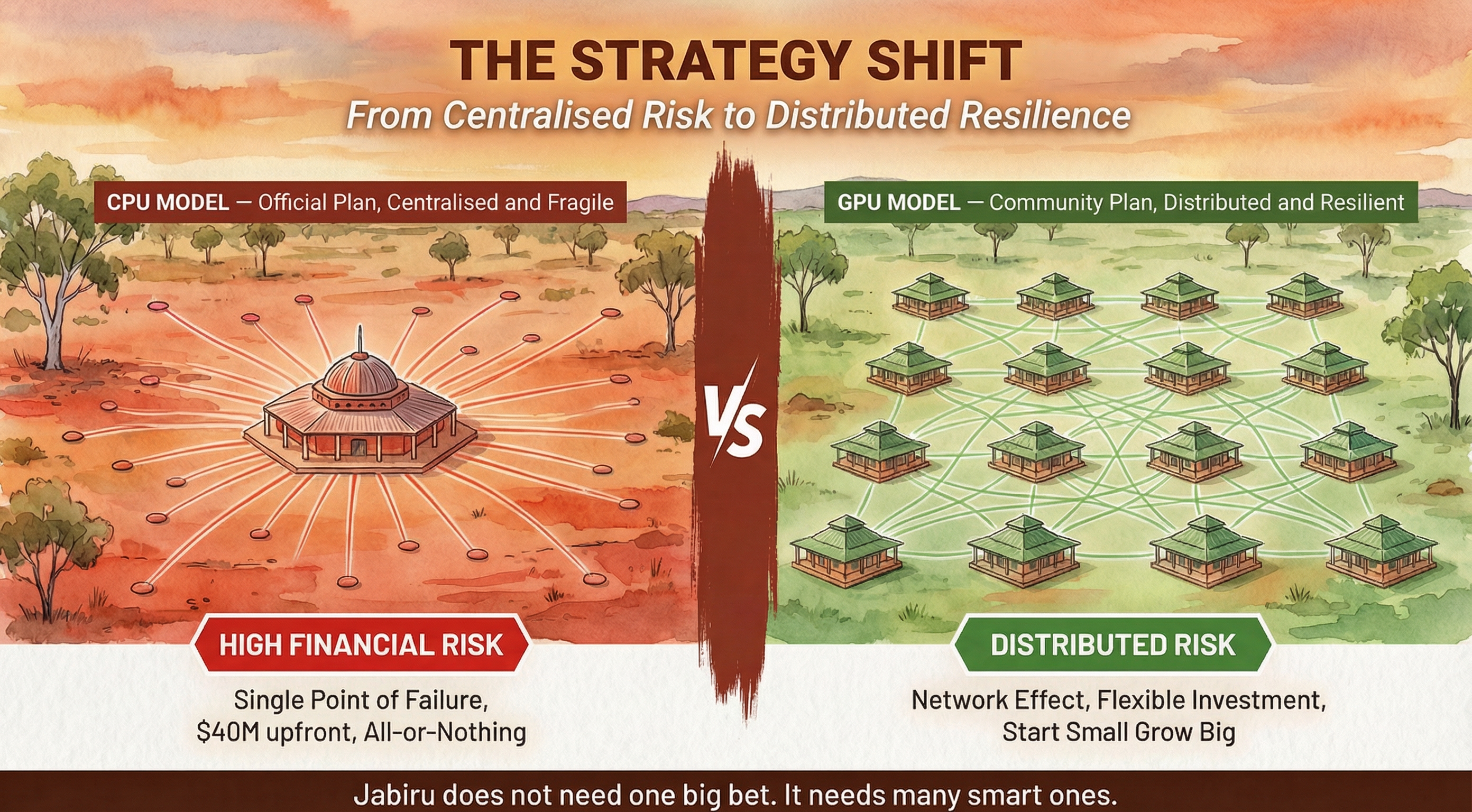
To understand the fundamental difference between the official masterplan and our Community Contribution, it helps to use an analogy from computing:
A single, powerful, expensive core — the monolithic World Heritage Centre. Sequential, top-down. If that one core fails to get funding, or overheats with cost overruns, the entire system fails. The town’s future is bottlenecked by a single point of failure.
Dozens of smaller, agile, specialised cores working in concert. Cultural Hearth, Community Precinct, Lakeside Village, Eco-lodges, and Dark Sky Observatory. They can be funded, built, and celebrated independently. If one project is delayed, the others continue. Together, they render a far richer, more vibrant picture of a living community.
This is the heart of our proposal: shifting from a rigid CPU mindset to a flexible GPU model for community development. Distributed systems that can absorb shocks and grow stronger from disruption are, as Taleb argues, fundamentally antifragile [33]. Portfolio-based public investment has been shown to outperform single-project concentration in risk management and mission alignment [37].
“Wind extinguishes a candle and energises a fire. Likewise with randomness, uncertainty, chaos: you want to use them, not hide from them. You want to be the fire and wish for wind.”
Source: NT Independent, David Wood, Dec 2020; Stafford Strategy Consultancy Group business case, June 2018. Full breakdown: $256.3M public investment + $133.5M public-private partnership + $56.2M privately funded commercial projects (incl. $48.1M five-star lodge & glamping). [22]
Part 2
The Spatial Masterplan — A Living Town
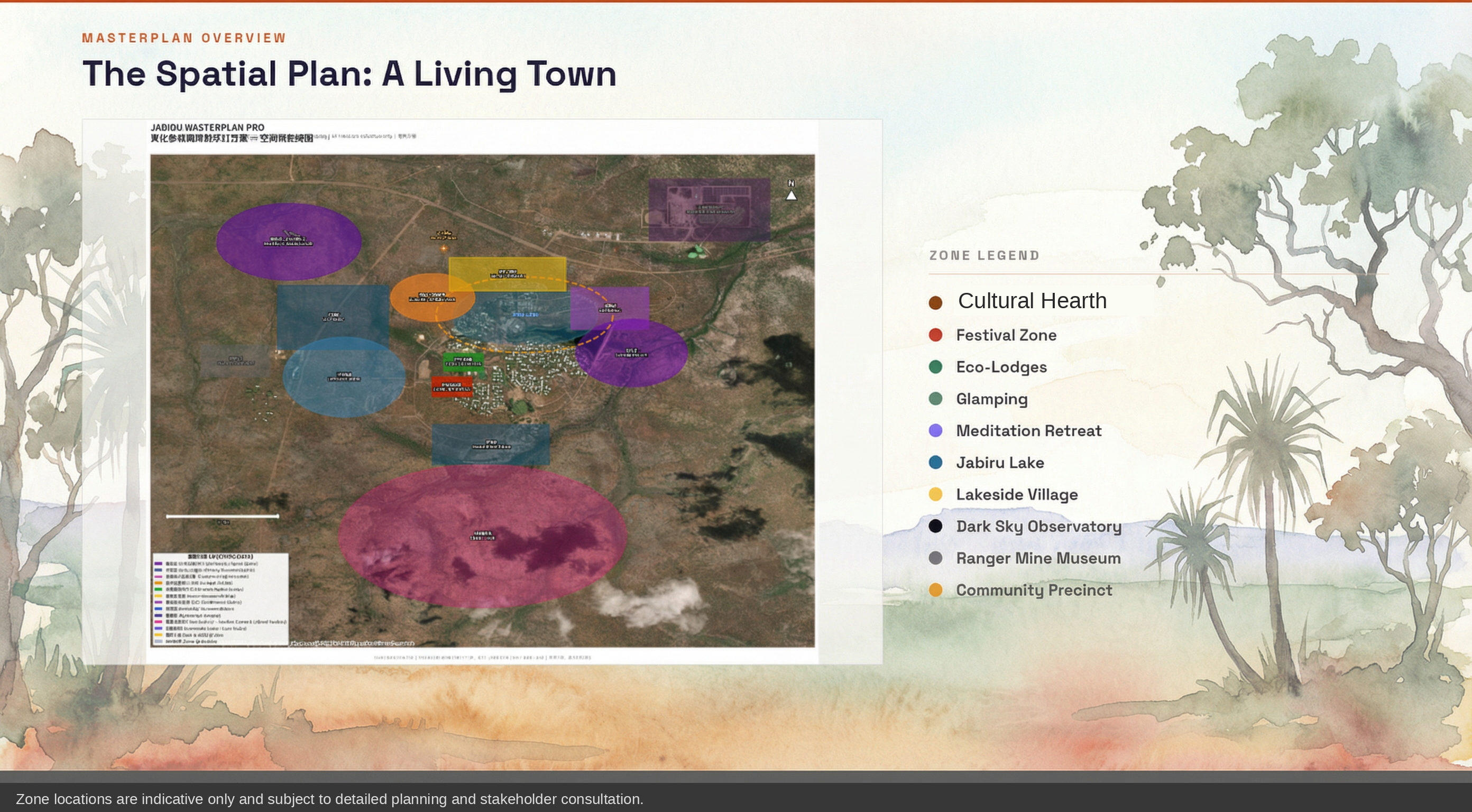
Our proposed spatial plan is a distributed network of zones, each with a specific purpose, that work together to create a vibrant and resilient town. It moves away from the centralised, single-attraction model to a more organic, polycentric layout.
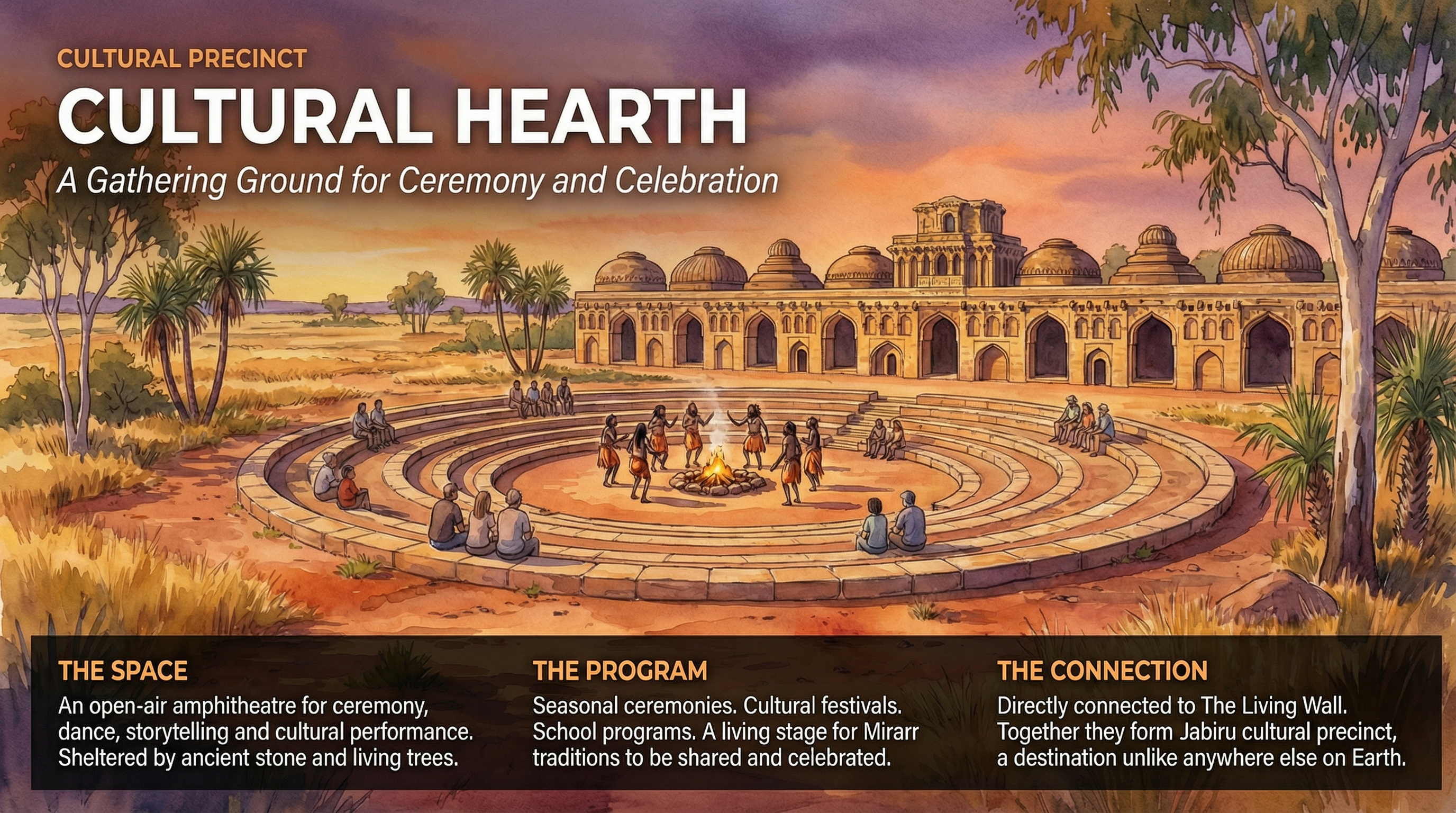
Cultural Hearth — The Cultural Heart
Located within the cultural precinct of Jabiru, in dialogue with existing arts and cultural institutions, forming a natural "Cultural Axis." Designed using a Three Circles Model: an inner, sacred core for the community only; a middle, shared ground for invited ceremony; and an outer, learning edge for all visitors. This is not a tourist attraction. It is the heart of the community. Research confirms that Indigenous-led cultural spaces, when developed on community terms, become the most authentic and enduring tourism assets a region can offer [34].
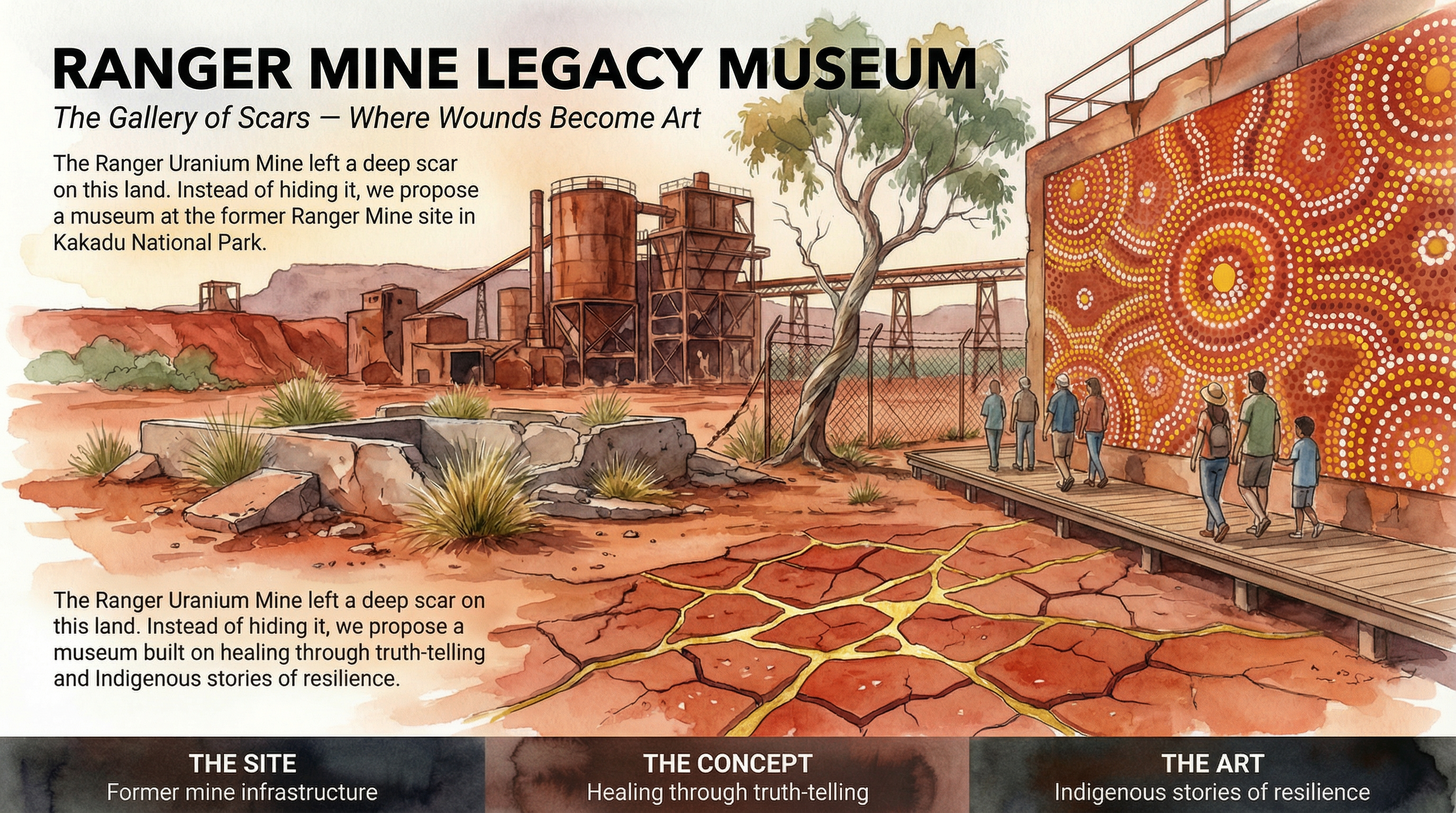
Ranger Mine Legacy Museum — The Scar Transformed
Located at the site of the former Ranger Uranium Mine. The concept is to transform a site of environmental and cultural trauma into a landmark museum — a significant institution of industrial history, environmental rehabilitation, and Indigenous resilience — honouring both the cultural memory and the scientific record of this land: the geology of uranium, the ecology of wetlands, the archaeology of Bininj culture, and the human story of a mining town. Built on healing through truth-telling. This is not about hiding the scar. It is about owning it. The Ranger Mine Closure Plan 2023 outlines progressive rehabilitation milestones, with full site rehabilitation now targeted for completion after 2028 [31]. The museum can begin taking shape as the land heals — the timeline of rehabilitation and the timeline of storytelling can run together.
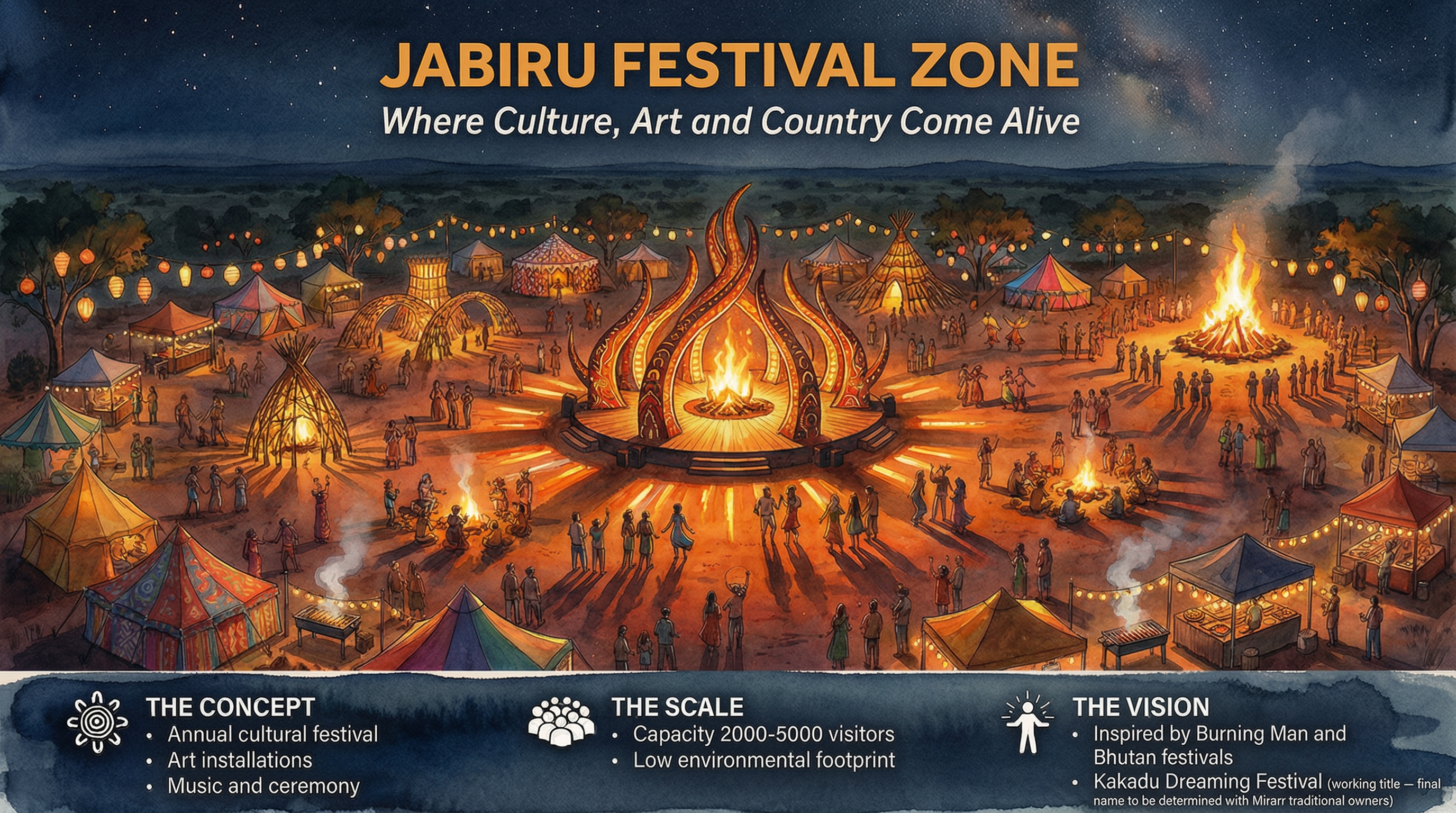
Festival Zone — The Heart of the Wild
A dedicated, large-scale outdoor venue for major events like the Mahbilil Festival, music concerts, and cultural gatherings. Designed to be far enough from residential areas to be loud, but close enough for residents to participate. It embraces the wildness of Kakadu as its stage. We envision an annual Kakadu Dreaming Festival (working title — final name to be determined with Mirarr traditional owners) during the dry season, inviting musicians and artists from across Australia and the world to collaborate with local Mirarr performers — subject to their consent and direction.
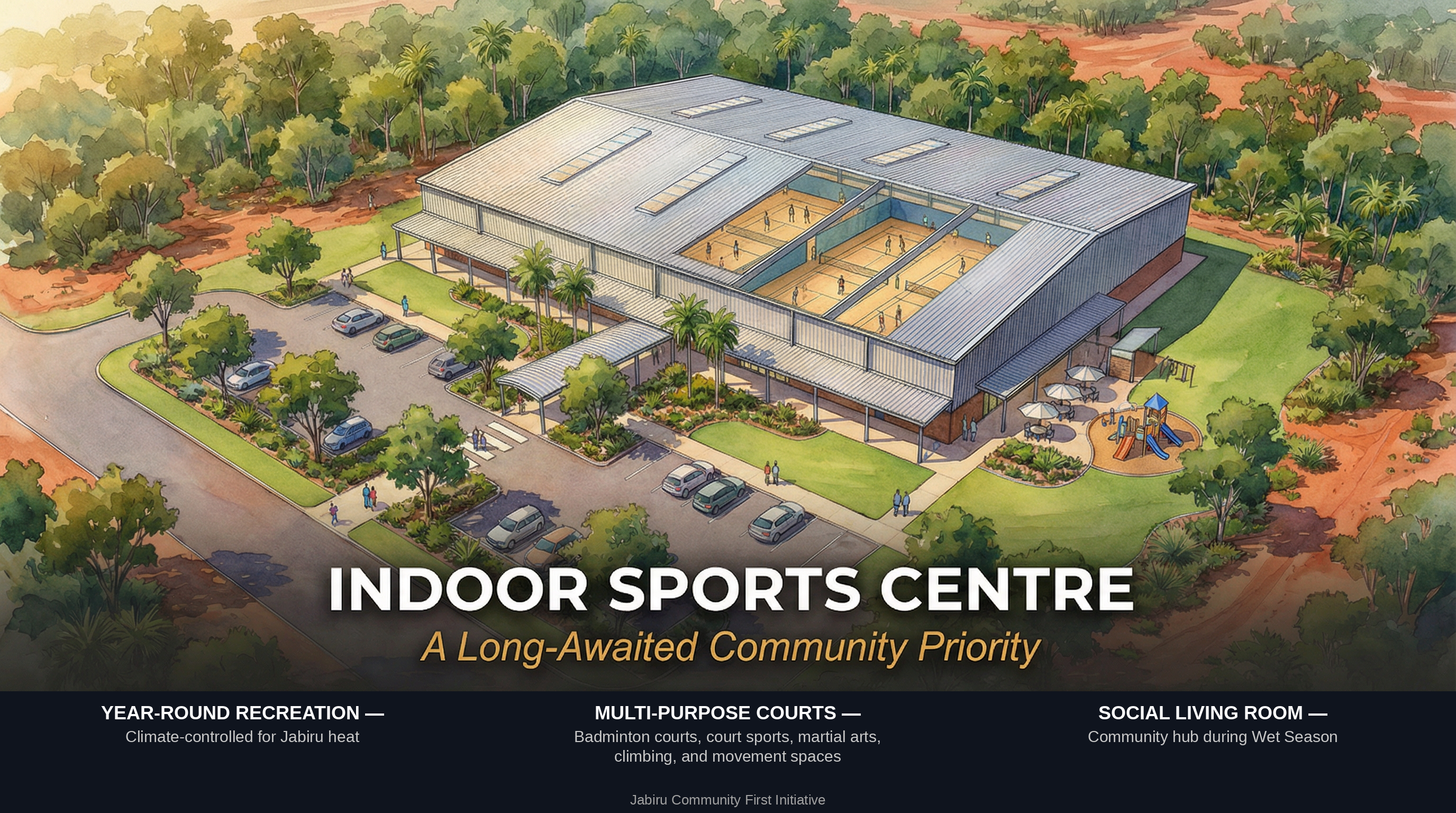
Community Precinct — The Social Core
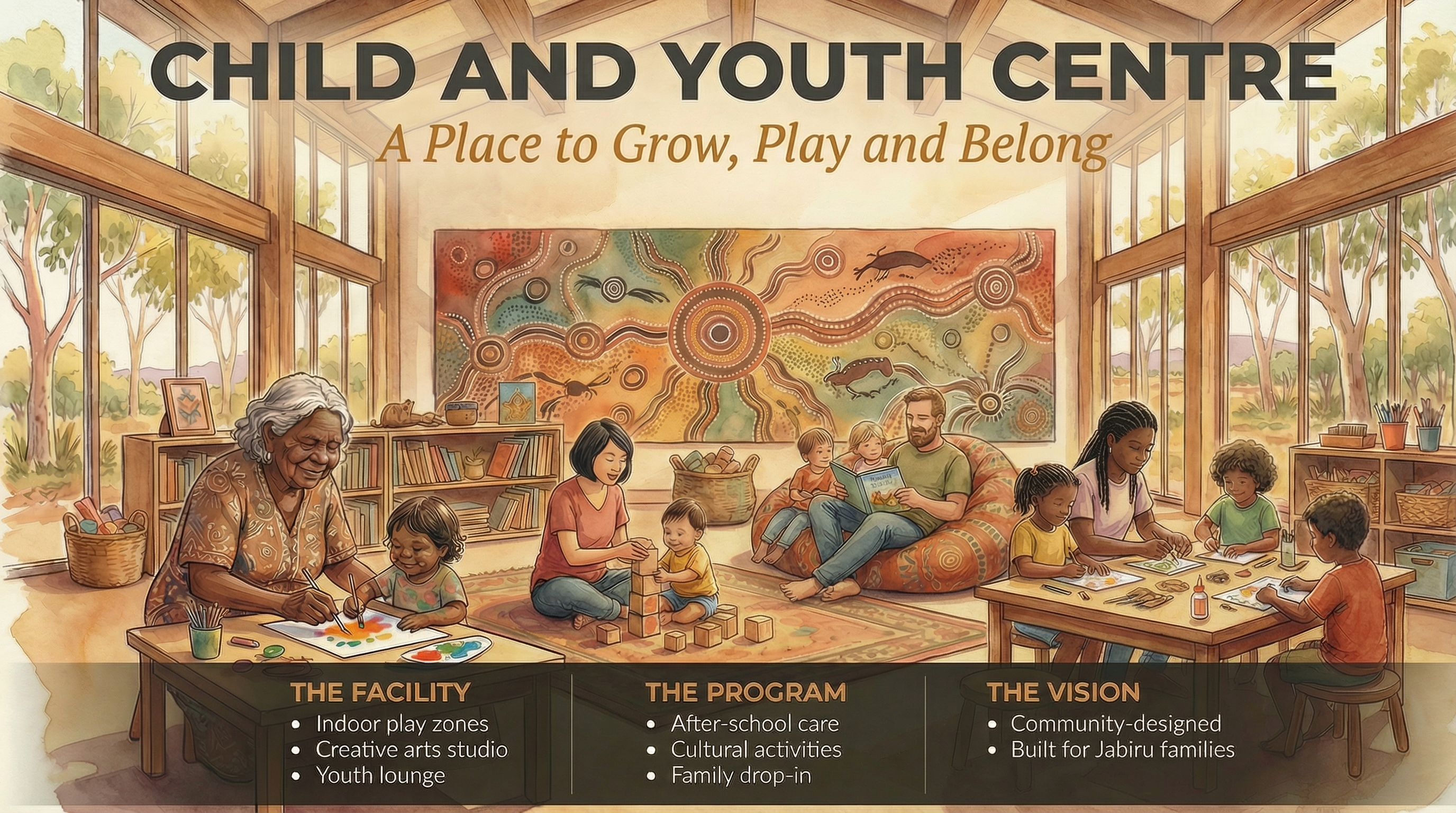
Located at the centre of the existing town. A hub for residents, consisting of two key facilities: An Indoor Sport & Wellness Centre — an all-weather facility with badminton courts, court sports, martial arts, climbing, and movement spaces, filling the gaps that Jabiru's scattered facilities currently cannot provide. Essential for retaining youth and families. A Child & Youth Centre — a safe, creative, and culturally grounded space where young children can play and learn, and teenagers can find mentorship, arts, and belonging. Designed with and for the Jabiru community. The Northern Territory Government’s own Youth Strategy Action Plan 2024–2027 identifies dedicated youth spaces and safe recreational infrastructure as a priority need across NT communities [35], and the Australian Government’s Northern Territory Remote Aboriginal Investment 2024–25 specifically funds place-based child and family services in remote NT communities [39] — both directly affirming the case for Jabiru’s proposed Child & Youth Centre.
Accommodation Zones — A Place to Stay
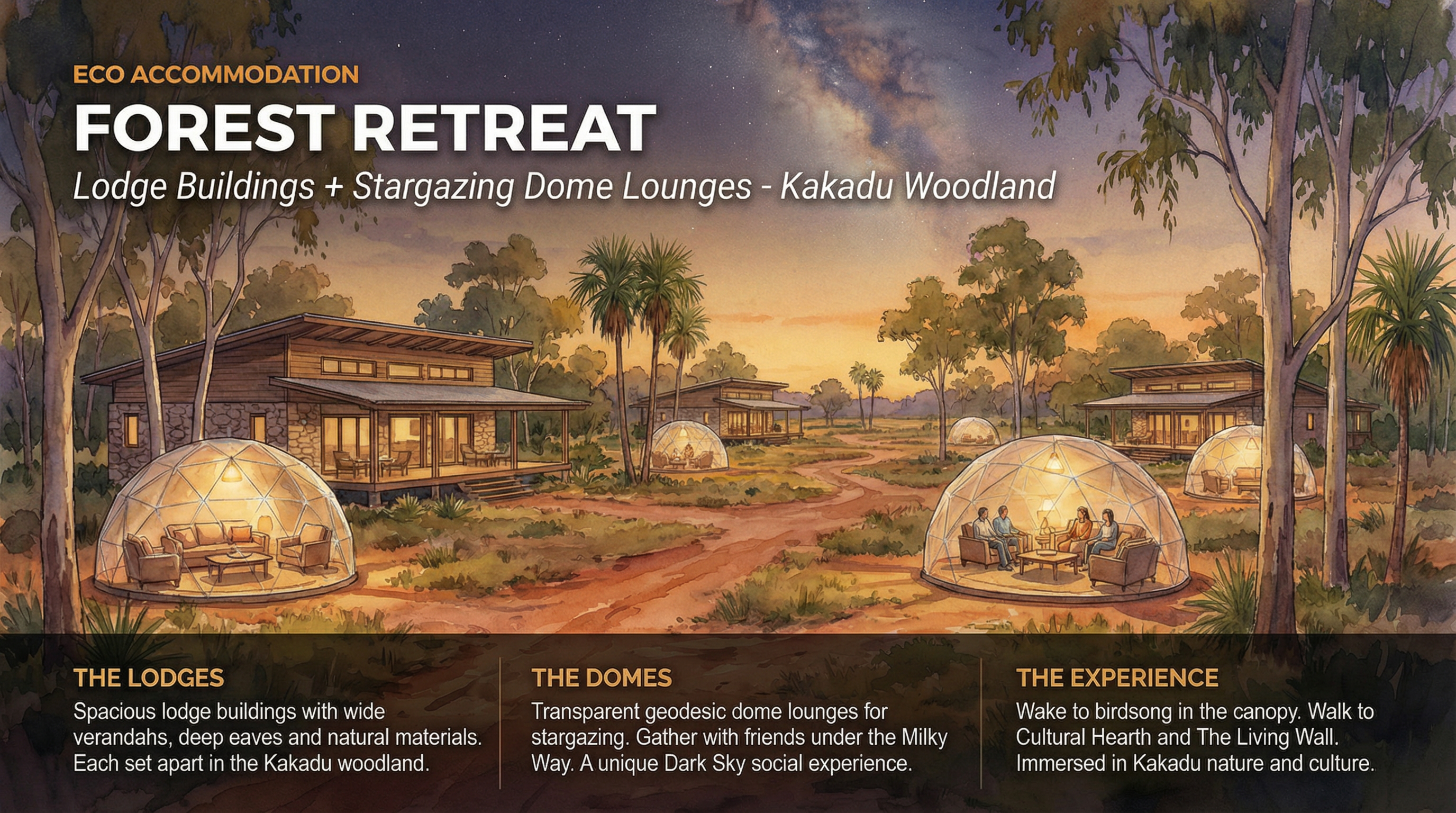
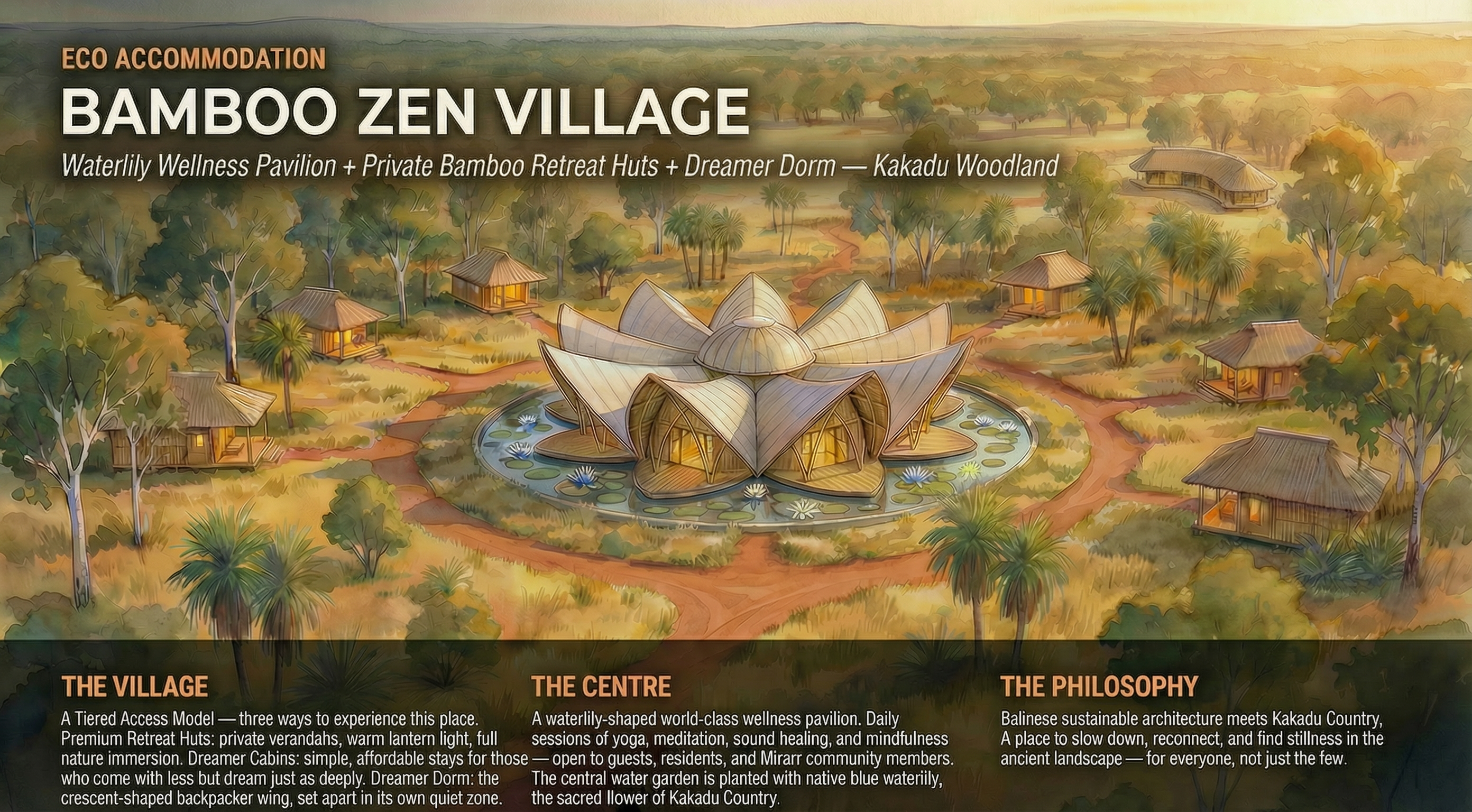
Three distinct accommodation offerings: Eco-Lodges — high-end, environmentally sensitive accommodation integrated with the natural landscape; Glamping & Camping — a more accessible and adventurous option for visitors; Bamboo Zen Village — a Waterlily Wellness Pavilion surrounded by private bamboo retreat huts, operating on a Tiered Access Model. Three tiers: Premium Retreat Huts (private verandahs, full nature immersion), Dreamer Cabins (affordable, simple stays), and Dreamer Dorm (a crescent-shaped backpacker wing set apart in its own quiet zone — for those who arrive with a backpack and a big dream). Daily wellness sessions open to guests, residents, and Mirarr community members. The central water garden is planted with native blue waterlily — the sacred flower of Kakadu Country. For everyone, not just the few.
Jabiru Lake — The Living Heart
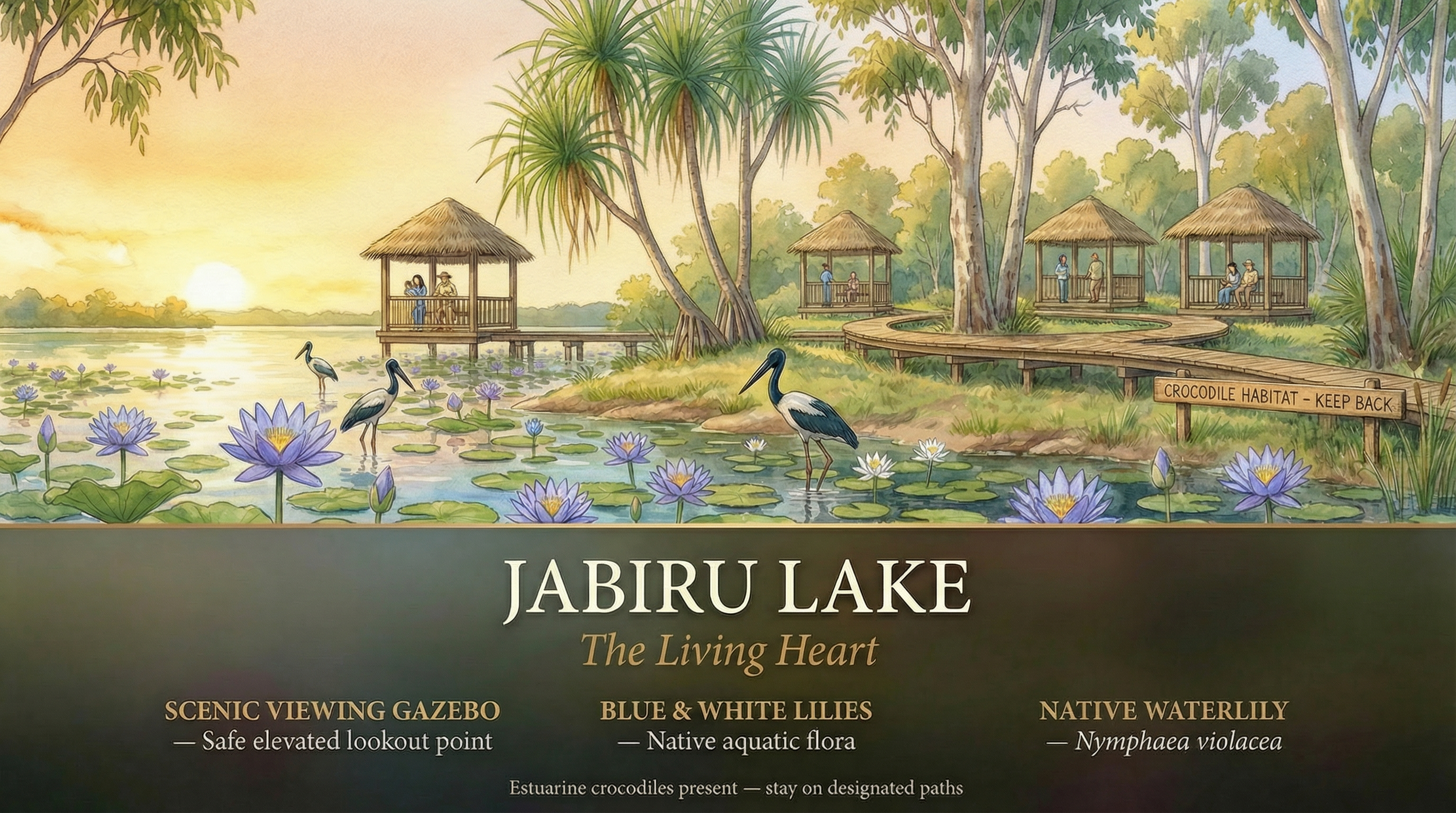
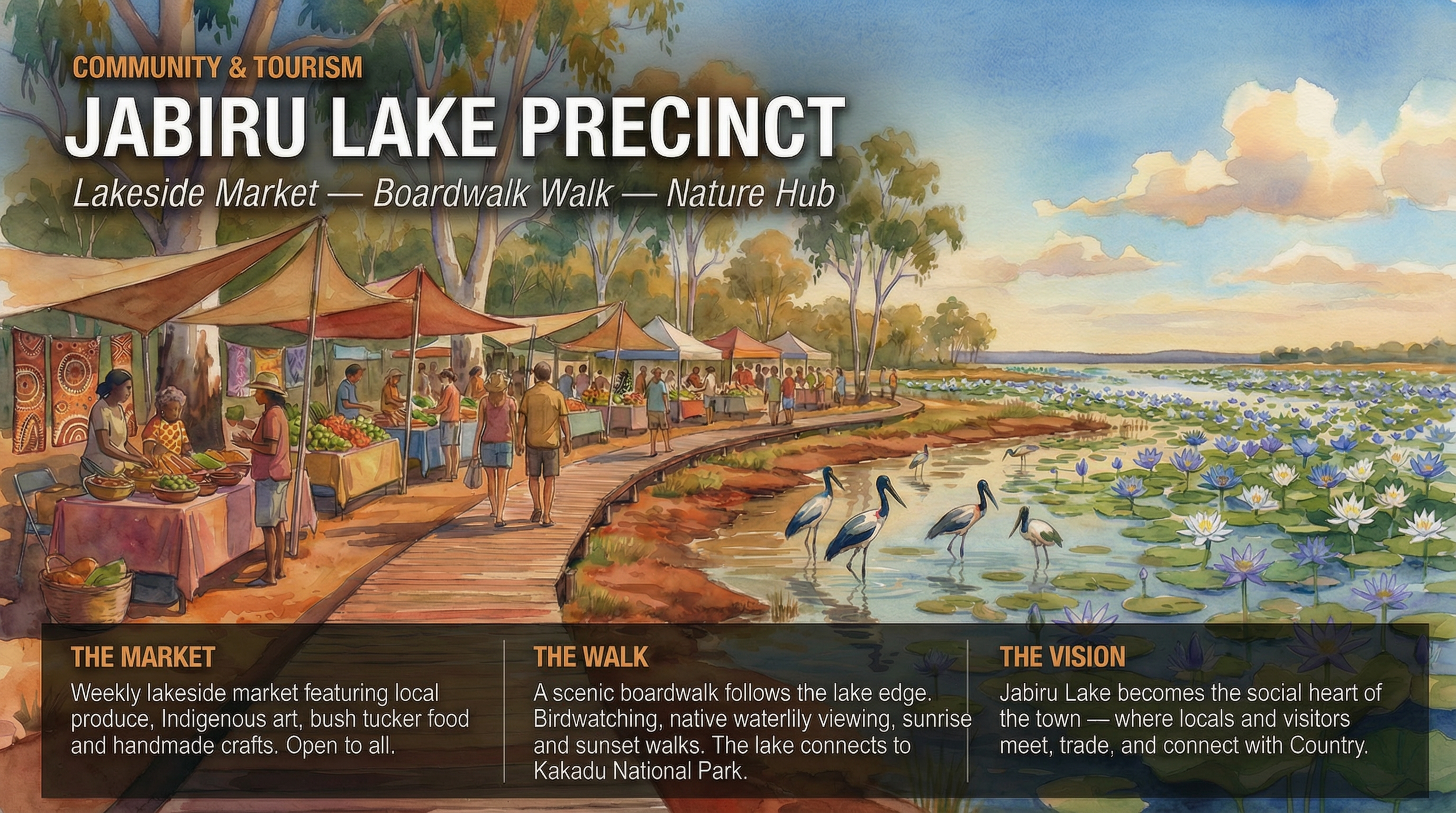
Jabiru Lake is the most underutilised asset in the entire town. The first intervention is Native Waterlily & Aquatic Planting — the lake surface will be planted with native waterlily and aquatic species, including culturally significant varieties, creating a stunning, ever-changing floral landscape that reflects the seasons and the life of the Country around it. The second is a Lakeside Walking & Cycling Trail — a continuous, accessible trail encircling the entire lake, connecting the Lakeside Village, Community Garden & Market, Visitor Commercial Strip, and residential areas. Two simple interventions. One living heart.
Economic & Visitor Hubs — Commerce & Community
Lakeside Village & Garden: a vibrant cluster of small-scale retail, cafes, and a community garden and market — all connected to the lake trail. Visitor Commercial Strip: a dedicated area for larger tourism operators and services. Bowali Visitor Centre (Existing): retained and elevated as the primary information hub.
Wildlife Rescue Centre — The Gentle Threshold
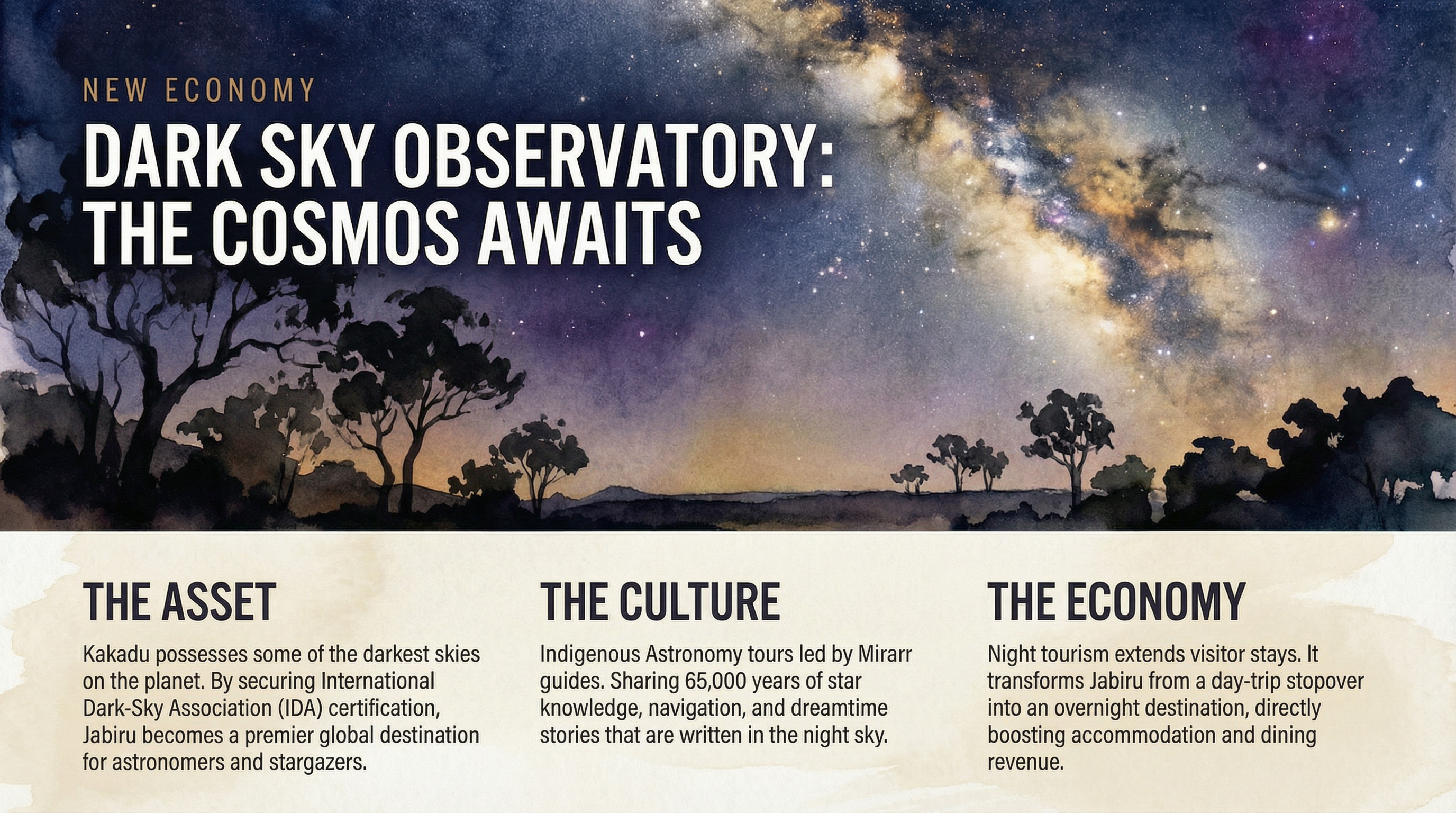
Kakadu is one of only a handful of places on Earth recognised as a UNESCO World Heritage site for both its natural and cultural values — a distinction that carries not just prestige, but responsibility. A full-service wildlife rescue and rehabilitation centre, with the Kakadu Wildlife Interpretation Wall spanning its exterior facade — a large mural with multilingual QR codes linking to official Kakadu National Park ecological information. Serving as a gateway between the town and the park, built to the highest environmental standards, it anchors a leisurely visitor route where people slow down, look closely, and leave understanding something they did not before. A living demonstration that people and wildlife can share the same space — not as spectacle, but as quiet neighbours. Kakadu is home to more than 75 threatened species — more than any other Australian conservation reserve [27]. This is not a local amenity. It is World Heritage conservation infrastructure — eligible for federal and international funding streams that a community centre could never access. [24][25][26][27] ✦ Designed to be developed in partnership with Mirarr Traditional Custodians, subject to their consent and direction.
Dark Sky Observatory & Cultural Stargazing — The Sky Has Always Been the Oldest Story
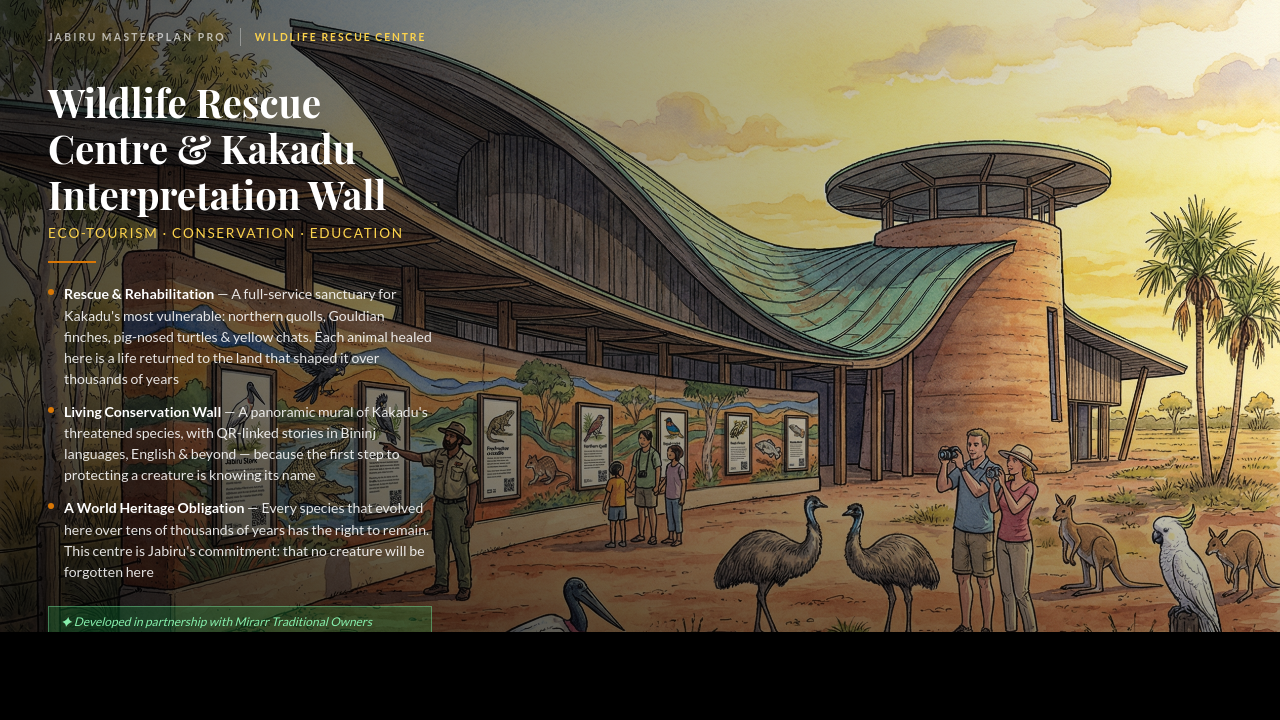
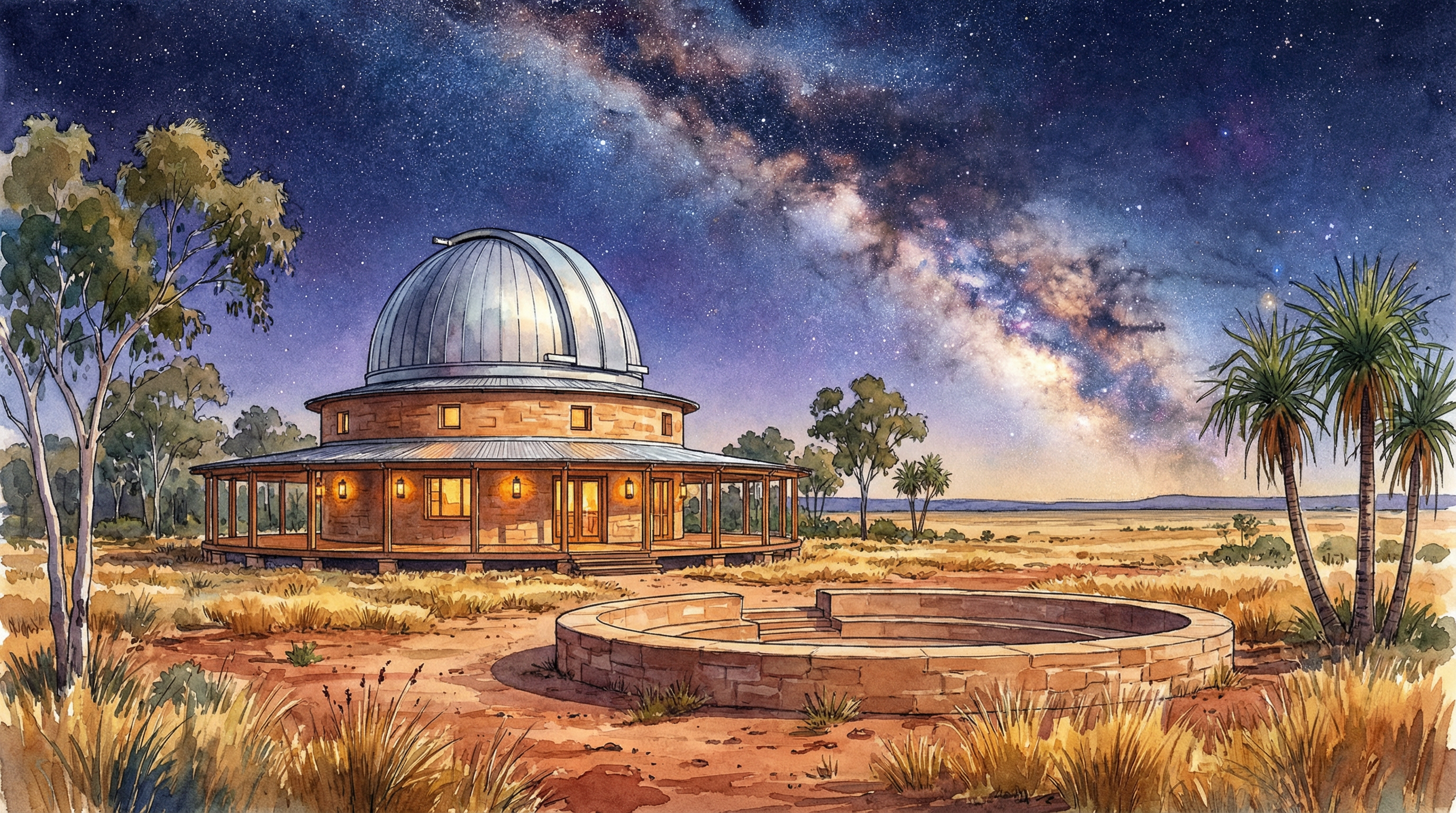
Kakadu's night sky is one of the last truly dark skies in the world — unobscured by light pollution, vast, and alive with the same stars that Bininj and Mungguy peoples have navigated and narrated for tens of thousands of years. Achieving International Dark Sky Reserve certification would give Jabiru a unique and permanent niche on the global tourism map, attracting astronomers, photographers, and travellers seeking something that most of the world has already lost. A modest observatory and open-air stargazing platform — designed to serve double duty: a daytime education and visitor centre for school groups and travellers, and a nighttime observatory open to the sky. Infrastructure in service of a knowledge system that needs no introduction. For Bininj and Mungguy peoples, the sky has always been a calendar, a map, and a library. This is simply a place to sit beneath it together. A dual-purpose design makes it eligible for both education infrastructure grants and tourism infrastructure funding — two streams that a single-use facility could never access. The universe is the same one. The stories are not. Astrotourism is one of the fastest-growing niches in sustainable travel, offering both knowledge dissemination and community economic benefit [32].
Living Pharmacy — Kakadu Bush Medicine Centre
Kakadu's plant life has sustained the Bininj and Mungguy peoples for tens of thousands of years. This knowledge — of which plants heal, which calm, which restore — is not folklore. It is a living pharmacopoeia, refined across generations, and increasingly recognised by modern science as a source of compounds with genuine medicinal potential. The Living Pharmacy is a bush medicine garden, research centre, and cultural education space in one. Its exterior garden is open to all — a curated landscape of medicinal native plants, each labelled in Bininj Kunwok, English, and scientific Latin, with QR codes linking to verified ecological and ethnobotanical information. Its inner research and teaching spaces operate under the direction of Mirarr knowledge holders, who determine what is shared, with whom, and on what terms. A place where a school group, a university researcher, and a traditional healer can each find something that belongs to them. This is not a museum of what was known. It is a living record of what is still known — and still growing. ✦ Designed to be developed in partnership with Mirarr Traditional Custodians, subject to their consent and direction. All traditional knowledge remains the intellectual property of its custodians. [28][29]
Part 3
The Financial Strategy — A Smarter Investment
The official plan commits $446 million in total investment — anchored by a $57.7 million World Heritage Interpretive Centre as its centrepiece. This represents a high-concentration, single-point approach where the success of the entire plan depends on one flagship building.
The economic case for investing in Jabiru is already well-established: Deloitte Access Economics independently assessed that Kakadu National Park supports over 1,180 jobs and contributes $136 million to the Australian economy each year, with a total social asset value of $10 billion [36]. These figures represent the baseline value of the existing park — the untapped potential of a thriving Jabiru town would multiply this contribution significantly.
The most compelling argument for our proposal is its strategic use of capital. Our plan focuses on spending smarter, not just spending less — distributing investment across a portfolio of smaller, targeted, and more fundable projects, each eligible for separate funding streams, and each delivering immediate, tangible value to the community.
This approach aligns with the strategic direction set out in the Kakadu Tourism Master Plan 2020–2030 [30], which prioritises culturally appropriate tourism developed in genuine partnership with Traditional Custodians — exactly the kind of distributed, community-first model we propose here.
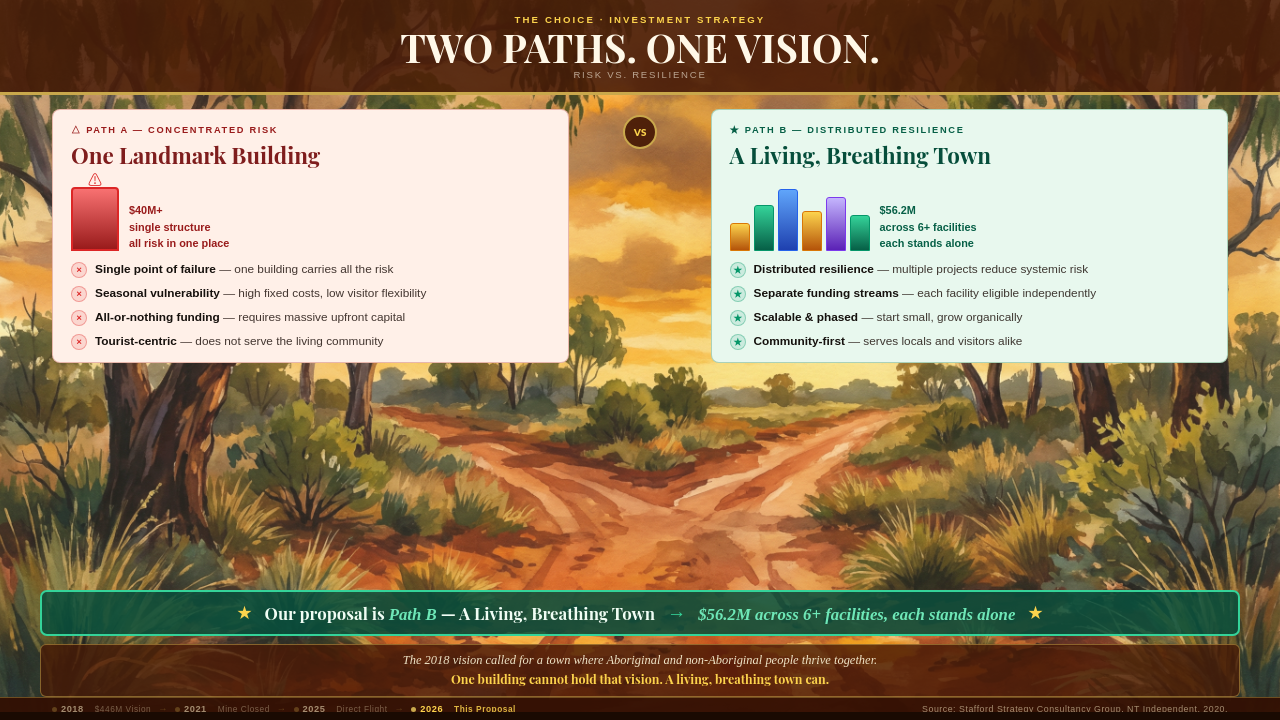
The core argument: We don't need a $40M building to watch culture. We need a town where culture lives.
TWO PATHS. ONE VISION.
A single landmark building concentrates all risk in one structure — vulnerable to seasonal downturns, shifting markets, and the weight of unmet expectations. When it struggles, everything struggles.
A distributed approach spreads that same investment across the town — eco-lodges, a lakeside market, a cultural hearth, a dark sky observatory, a wellness retreat. Each facility stands on its own. Each serves a different visitor, a different season, a different need. If one is quiet, the others carry on.
The 2018 vision called for a town where Aboriginal and non-Aboriginal people thrive together. One building cannot hold that vision. A living, breathing town can.
Part 4
Phasing & Funding — How We Get It Done
This is not just a dream. It is a proposal for an achievable, pragmatic roadmap.
Projects
Indoor Sports Centre, Child & Youth Centre, Cultural Hearth
Funding
Federal/NTG Community Infrastructure Grants, Dept. of Social Services, Aboriginals Benefit Account (ABA)
Rationale
Build the community first. Deliver immediate benefits to residents.
Projects
Eco-Lodges, Glamping, Lakeside Village, Wildlife Rescue Centre & Interpretation Wall
Funding
Primarily Private Sector Investment, supported by Tourism NT and small business grants. Wildlife Centre: World Heritage conservation funding streams.
Rationale
Attract private capital to build the economic engine of the new Jabiru.
Projects
Ranger Mine Legacy Museum, Festival Zone, Dark Sky Observatory, Living Pharmacy — Kakadu Bush Medicine Centre
Funding
Mine rehabilitation and closure funds, NTG Major Events grants, University partnerships, NHMRC, WHO Traditional Medicine Strategy 2025–2034
Rationale
Deliver the iconic, world-class projects, funded by the stakeholders with the greatest interest in Jabiru's future.
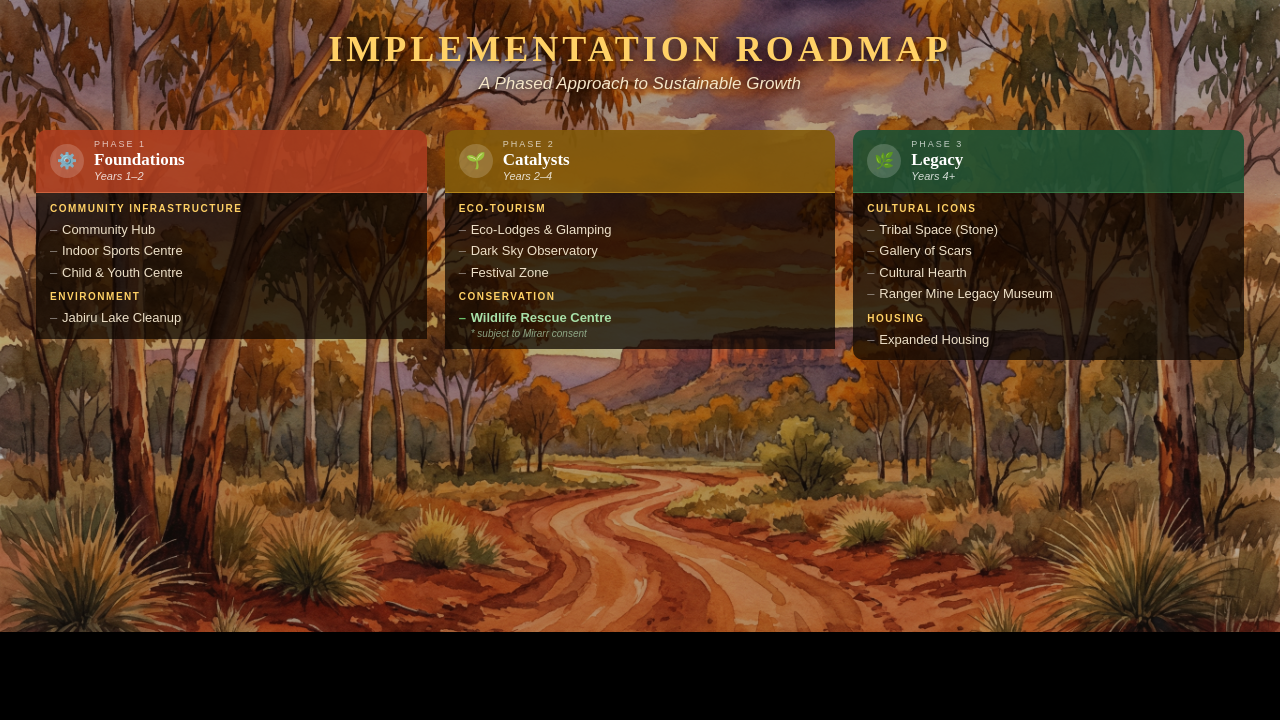
The required core government funding for our plan is estimated to be a fraction of the cost of a single World Heritage Centre — with the majority of investment leveraged from private sector partners and stakeholders with existing legal obligations.
The funding environment is also highly favourable. In February 2025, the Australian Government committed $842.6 million over six years through the NT Remote Aboriginal Investment (NTRAI) — described as the "largest investment in remote communities we have seen" — specifically to deliver services including child and family centres, community development, and support for Aboriginal community-controlled organisations in remote NT communities [40]. Jabiru, as a remote community within Kakadu, sits squarely within the remit of this investment.
Part 5
Conclusion — A Call to Action
This Community Contribution is more than a plan; it is a declaration of what Jabiru can and should be. It is a vision for a town that is economically resilient, culturally rich, environmentally responsible, and, above all, a true home for its people.
The window is open. The direct Guangzhou–Darwin route is running. The Ranger Mine site is being rehabilitated. The conditions for change are as favourable as they have ever been. We offer this contribution not as a demand, but as an invitation — to those with the authority and the will to help Jabiru become what it has always had the potential to be.
Let's build a living town.
Appendix
World-Class Precedents
A Global Blueprint for Jabiru's Viable Transformation
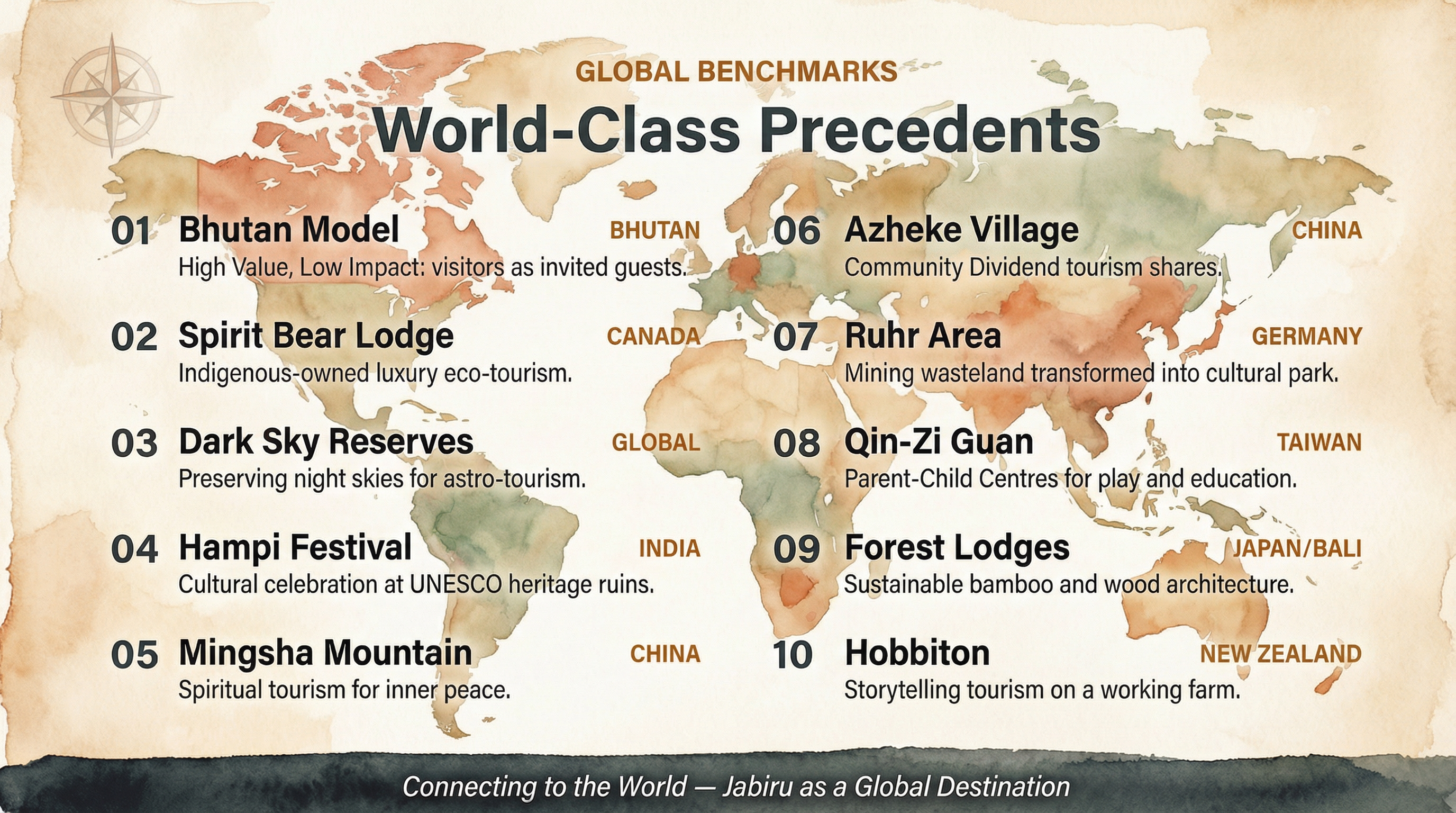
Our "Jabiru Masterplan Pro: The Community Contribution" is not a fantasy conceived in a vacuum. It is rooted in the practical experience of the world's most successful community transformations, cultural revivals, and sustainable tourism initiatives. These cases are not for simple replication; they are the compass by which we calibrate Jabiru's future.
Core Concept
The Kingdom of Bhutan pioneered a tourism policy centered on "Gross National Happiness," treating visitors as "invited guests." By levying a daily Sustainable Development Fee (SDF), it ensures that tourism development directly contributes to environmental protection, cultural preservation, and community building.
Application in Jabiru
Our "Eco-Lodges," "Glamping Zone," and "Kakadu Knowledge Guide Certification" programs are direct applications of this philosophy. Fees paid by tourists will directly fund local guides, maintain the national park's natural environment, and support Indigenous cultural projects.
Core Concept
Wholly owned and operated by the Kitasoo/Xai'xais First Nation, Spirit Bear Lodge proves that a community can create a world-class tourism experience by sharing its traditional territory and cultural knowledge, while simultaneously protecting endangered ecosystems.
Application in Jabiru
This provides the perfect model for our "Cultural Hearth" and "Festival Zone." We propose that operational control of these spaces be offered to the Mirarr people, subject to their consent and direction, ensuring cultural sovereignty and authenticity.
Core Concept
Located in the core of the Hani Rice Terraces World Heritage site in Yunnan, Azheke village successfully transformed from a near-hollowed-out settlement into a vibrant destination by introducing a "tourism village manager" and a dividend-sharing system for residents.
Application in Jabiru
This case inspires our "Community Garden & Market." We recommend establishing a management committee led by community residents — including, if they wish to participate, Mirarr elders — to oversee daily operations and cultural programming, subject to their consent and direction. Research on Australian rural farmers' markets confirms that community-run markets generate significant local economic multiplier effects and strengthen social cohesion [38].
Core Concept
Germany's Ruhr Area converted abandoned coal mines and steel mills into museums, concert halls, parks, and creative hubs. Similarly, Broken Hill in Australia has leveraged its mining heritage as a cultural tourism asset.
Application in Jabiru
Our proposal does not seek to erase the history of the Ranger Mine but to transform it into Jabiru's unique narrative — the Ranger Mine Legacy Museum (The Scar Transformed) — and, subject to regulatory approval, parts of the mine site could be considered for conversion into an industrial landscape art park.
Core Concept
Certification from the International Dark-Sky Association (IDA) provides a global brand for places with pristine, light-pollution-free night skies. From Lake Tekapo in New Zealand to Utah in the United States, dark-sky tourism has become a rapidly growing, high-value market.
Application in Jabiru
The Kakadu region possesses a world-class pristine night sky. Achieving Dark Sky Reserve certification would give Jabiru a unique niche on the global tourism map. Indigenous guides sharing creation stories under the stars — subject to their consent and direction — would offer an inimitable, profound experience.
Core Concept
As the capital of the ancient Vijayanagara Empire, Hampi hosts the annual "Hampi Utsav," bringing the silent stone monuments to life with music, dance, drama, and light shows, greatly enhancing the local community's cultural identity and pride.
Application in Jabiru
This is the direct inspiration for our "Festival Zone." We envision an annual "Kakadu Dreaming Festival" during the dry season, inviting musicians and artists from across Australia and the world to collaborate with local Mirarr performers — to be developed in partnership with Mirarr traditional owners and Parks Australia, subject to their consent and direction.
Core Concept
Widely established in Taiwanese cities, these government-funded centers are free and open to families with children aged 0–6. They provide safe play environments, resources, and professional social workers and educators who offer parenting advice and courses.
Application in Jabiru
Our "Child & Youth Centre" draws inspiration from this model — adapting its core principles of accessible, professional, and community-centred family support to the unique context of Jabiru. It is not just a playground but a comprehensive community support hub that will address the critical shortage of childcare and ensure the healthy development of the next generation.
Core Concept
From Japan's "Treeful Treehouse" to Bali's "Green Village," these projects show how sustainable materials like bamboo and wood can create architecture that is both modern and comfortable while blending perfectly with the surrounding forest.
Application in Jabiru
This provides the design blueprint for our "Eco-Lodges" and "Glamping Zone." We will use elevated designs to minimise ground disturbance, source local or renewable materials, and incorporate green technologies like passive ventilation and solar power.
Core Concept
New Zealand's Hobbiton transformed a working farm in the Waikato region into a world-famous destination by embracing a fictional cultural narrative — proving that a strong, imaginative identity can turn an ordinary place into an extraordinary one. Japan's Nishiawakura village achieved economic self-sufficiency by promoting a "100-Year Forest Vision."
Application in Jabiru
These cases prove that a strong, distinctive cultural identity is the foundation of authentic local revitalisation. Jabiru's identity is rooted in the living ecology of Kakadu and the creation stories of the Mirarr people — stories that belong to Country, and can only be shared on Country's own terms. Our "Lakeside Village" will be designed in respectful dialogue with these core elements. Kakadu's total economic contribution has been independently assessed at $136 million annually in direct economic value added, with a social asset worth $10 billion [36].
Core Concept
A growing number of travelers seek deeper experiences beyond photo-ops — spiritual healing, a connection with nature, and contemplation of the universe. This trend is evident from visitors traveling to China's Mingsha Mountain to the global rise of retreats, meditation, and astro-tourism.
Application in Jabiru
This is the highest value proposition of our entire proposal. The uniqueness of Jabiru and Kakadu lies in its ability to offer this profound, soul-stirring experience. Our "Lakeside Contemplation Zone," the waterlily-filled Jabiru Lake, the dark night sky, and the ancient wisdom of Mirarr culture combine to form a powerful "spiritual healing ground."
The official masterplan faces a fundamental challenge: it relies on a single, large infrastructure investment in a place that needs many small, living things. Our Community Contribution starts from Jabiru's own cultural and natural endowments and draws wisdom from the world's best practices. These precedents collectively point toward a smarter, more sustainable, and more humane path — one that Jabiru is uniquely positioned to take.
References
References
- [1]Bhutan Tourism Council. (2023). Sustainable Development Fee (SDF). https://bhutan.travel/journal/editorial/bhutan-s-sustainable-development-fee
- [2]World Economic Forum. (2023, September 13). How is Bhutan trying to become a sustainable tourist destination? https://www.weforum.org/stories/2023/09/bhutan-sustainable-tourist-destination/
- [3]Spirit Bear Lodge. (2021, June 1). Sustainable Tourism in the Great Bear Rainforest. https://spiritbear.com/sustainable-tourism-in-the-great-bear-rainforest/
- [4]Coast Funds. (2018, March 9). The Success of Spirit Bear Lodge. https://coastfunds.ca/stories/the-success-of-spirit-bear-lodge/
- [5]Zhang, L. & Stewart, W. (2017). Sustainable Tourism Development of Landscape Heritage in a Rural Community: A Case Study of Azheke Village at China Hani Rice Terraces. Built Heritage, 1(4), 37–51. Peer-reviewed study on community-based sustainable tourism at a UNESCO World Heritage rural landscape in China. https://doi.org/10.1186/bf03545656
- [6]China Daily. (2025, February 19). A village reborn through tourism. https://www.chinadaily.com.cn/a/202502/19/WS67b50723a310c240449d5f42.html
- [7]UNESCO World Heritage Centre. (n.d.). Zollverein Coal Mine Industrial Complex in Essen. https://whc.unesco.org/en/list/975/
- [8]NRW Tourism. (n.d.). UNESCO World Heritage Zollverein. https://www.nrw-tourism.com/unesco/zollverein
- [9]City of Broken Hill. (2021). Broken Hill National Heritage Values Study. https://www.brokenhill.nsw.gov.au/files/assets/public/documents/strategies-and-other-documents/broken-hill-national-values-study-april-2021.pdf
- [10]DarkSky International. (2018). International Dark Sky Reserve Program Guidelines. https://darksky.org/app/uploads/2018/12/IDSR-Guidelines-2018.pdf
- [11]Miles Partnership. (2025, January 7). Dark Sky Tourism Part 1. https://www.milespartnership.com/how-we-think/article/dark-sky-tourism-part-1-how-embracing-night-sky-can-benefit-dmos
- [12]Karnataka Tourism. (n.d.). Hampi Utsava: A Grand Celebration of the Vijayanagara Empire. https://karnatakatourism.org/en/events/hampi-utsav
- [13]UNESCO World Heritage Centre. (n.d.). Group of Monuments at Hampi. https://whc.unesco.org/en/list/241/
- [14]Taiwan Ministry of Health and Welfare. (n.d.). Parent-Child Center (Qin-Zi Guan) Service Quality Improvement Plan. https://www.sfaa.gov.tw/SFAA/Pages/Detail.aspx?nodeid=1202&pid=12087
- [15]Treeful Treehouse Sustainable Resort. (n.d.). Treeful Treehouse, Okinawa. https://en.treeful.net/
- [16]Green Village Bali. (n.d.). Green Village Bali: Home. https://greenvillagebali.com/
- [17]Nishiawakura Village. (n.d.). Nishiawakura Village: Sustainability. https://www.nishiawakuravillage.com/
- [18]Hobbiton Movie Set. (n.d.). Hobbiton Movie Set Tours, Matamata, New Zealand. https://www.hobbitontours.com/
- [19]Forbes. (2024, December 19). Spiritual Tourism Thrives As Travelers Seek Self-Enrichment Journeys. https://www.forbes.com/sites/rogersands/2024/12/19/spiritual-tourism-thrives-as-travelers-seek-self-enrichment-journeys/
- [20]Global Wellness Institute. (2024). Wellness Tourism Initiative Trends for 2024. https://globalwellnessinstitute.org/global-wellness-institute-blog/2024/04/30/wellness-tourism-initiative-trends-for-2024/
- [21]Into Travel China. (n.d.). Mingsha Mountain and Crescent Moon Spring, Dunhuang. https://www.intotravelchina.com/attractions/dunhuang_attraction/Crescent_Moon_Spring.html
- [22]Wood, D. (2020, December 20). The uncertain future of 40 people caught up in a mega $446 million redevelopment plan. NT Independent. https://ntindependent.com.au/the-uncertain-future-of-40-people-caught-up-in-a-mega-446-million-redevelopment-plan/
- [23]Department of Trade, Business and Asian Relations, Northern Territory Government. (2025, August 29). China Southern launches new Guangzhou – Darwin route. 3-weekly services commencing 3 December 2025, delivering 52,000 seats annually between Darwin and Guangzhou. https://dtbar.nt.gov.au/news/2025/china-southern-launches-new-guangzhou-darwin-route
- [24]DCCEEW. (2025). Saving Native Species Program. Australian Government Department of Climate Change, Energy, the Environment and Water. https://www.dcceew.gov.au/environment/biodiversity/threatened/saving-native-species
- [25]WTTC (World Travel & Tourism Council). (2024). The Economic Impact of Global Wildlife Tourism. https://researchhub.wttc.org/product/economic-impact-of-global-wildlife-tourism
- [26]Higginbottom, K. & Scott, N. (2008). Strategic planning of wildlife tourism in Australia. Journal of Ecotourism, 7(2–3), 136–153. https://www.tandfonline.com/doi/abs/10.1080/14724040802140485
- [27]IUCN. (2024). The IUCN Red List of Threatened Species. Version 2024-2. International Union for Conservation of Nature. Authoritative global database of the conservation status of species, including multiple Kakadu-endemic fauna. https://www.iucnredlist.org/
- [28]CSIRO. (2023). Indigenous Plant Knowledge and Pharmacological Research — Collaborative Frameworks for Ethical Research Partnerships. CSIRO Land and Water. https://www.csiro.au/en/research/natural-environment/land/indigenous-land-management
- [29]World Health Organization. (2023). WHO Traditional Medicine Strategy 2025–2034. Geneva: WHO. Global framework for integrating traditional, complementary and herbal medicine into national health systems. https://www.who.int/publications/i/item/9789240062764
- [30]Parks Australia. (2024). Kakadu Tourism Master Plan 2020–2030: Summary (April 2024 update). Australian Government. A 10-year strategy to grow culturally appropriate tourism in Kakadu, developed in consultation with Traditional Custodians and the community. https://kakadu.gov.au/static/5753fad9064b256cb16c6aa8d21a2f72/kakadu-tourism-master-plan-2020-2030_summary_april_2024.pdf
- [31]Energy Resources of Australia (ERA). (2023). Ranger Mine Closure Plan 2023. Rio Tinto / ERA. Comprehensive rehabilitation and closure plan for the Ranger uranium mine site within Kakadu National Park, outlining progressive rehabilitation milestones and post-closure land use. https://www.energyres.com.au/uploads/Revised-2023-RMCP-Main-Document.pdf
- [32]Fayos-Solà, E. & Marín, C. (2014). Astrotourism: No Requiem for Meaningful Travel. PASOS: Revista de Turismo y Patrimonio Cultural, 12(4), 663–671. Foundational academic paper defining astrotourism and its role in sustainable regional development. http://www.pasosonline.org/Publicados/12414/PS0414_01.pdf
- [33]Taleb, N. N. (2012). Antifragile: Things That Gain from Disorder. New York: Random House. Theoretical framework for distributed, resilient systems that strengthen under volatility — the philosophical basis for the GPU model of development. https://www.penguinrandomhouse.com/books/176227/antifragile-by-nassim-nicholas-taleb/
- [34]Ruhanen, L. & Whitford, M. (2019). Cultural heritage and Indigenous tourism. Journal of Heritage Tourism, 14(3), 179–191. Peer-reviewed study of conditions for successful Indigenous-led cultural tourism, cited 215 times. https://www.tandfonline.com/doi/full/10.1080/1743873X.2019.1581788
- [35]Northern Territory Government. (2024). Northern Territory Youth Strategy Action Plan 2024–2027. Department of Territory Families, Housing and Communities. Identifies dedicated youth spaces and safe recreational infrastructure as a priority need across NT communities, with particular emphasis on remote and regional areas. https://dpsc.nt.gov.au/media/docs/general-documents/nt-youth-strategy-action-plan.pdf
- [36]Deloitte Access Economics, commissioned by the Department of the Chief Minister (NT). (2020). The Economic and Social Value of Kakadu National Park. Estimates the total economic contribution of Kakadu National Park to the regional and national economy, including tourism expenditure, employment (1,180 jobs), direct economic value added ($136M/year), and total social asset value ($10 billion). https://cmc.nt.gov.au/media/docs/strategies-and-plans/deloitte-kakadu-national-park-value.pdf
- [37]Roberts, P. (2023). Portfolio management: A new direction in public sector investment. Public Administration Review, 83(4). Peer-reviewed analysis of how portfolio-based approaches to public investment outperform single-project concentration in terms of risk management and mission alignment. https://onlinelibrary.wiley.com/doi/10.1111/puar.13633
- [38]Coster, M. (2005). 'New Generation' Farmers' Markets in Rural Communities. Australian Food Timeline. Academic study of the economic and social multiplier effects of farmers' markets in rural Australian communities, including income retention and community cohesion. https://australianfoodtimeline.com.au/wp-content/uploads/2019/02/New-Generation-Famers-Markets-in-Rural-Communities-1.pdf
- [39]Australian Government & Northern Territory Government. (2024). Northern Territory Remote Aboriginal Investment 2024–25 — Child and Family Schedule. Federation Funding Agreements. Federal funding schedule supporting Aboriginal families, women and young people in remote NT communities through place-based child safety, family support, and wellbeing services. https://federalfinancialrelations.gov.au/sites/federalfinancialrelations.gov.au/files/2024-07/NTRAI%202024-25%20Child%20and%20Family%20Schedule.pdf
- [40]Pillarisetty, A., Bowles, A. & Hislop, J. (2025, February 6). Federal government pledges $840 million towards Closing the Gap in remote NT communities. ABC News. Reports the Australian Government's $842.6 million, six-year NTRAI commitment — described as the 'largest investment in remote communities we have seen' — including funding for up to 12 Aboriginal community-controlled children and family centres. https://www.abc.net.au/news/2025-02-06/federal-government-live-842-million-nt-remote-communities/104905750
Jabiru Masterplan Pro
Independent community vision. Does not represent the views of Mirarr Traditional Custodians or any government body.
Back to Slides